You’ve booked your course. Or you’re close to booking it. Either way, the same question is probably turning over in your mind: what is it actually going to be like?
Seven days on a sailing yacht in the Aegean — living, sleeping, and learning on board — is not like any other kind of course or holiday. It’s more immersive, more physical, and more rewarding than most people expect. It’s also more comfortable, more sociable, and less daunting than many first-timers fear.
This is a straightforward account of what actually happens, from the moment you arrive at Alimos Marina to the moment you leave with your certificate. No glossy brochure language. Just an honest picture of the week.
Before You Arrive
You don’t need to do anything special to prepare for an RYA Competent Crew course — that’s the point of it. Turn up willing to learn and ready to get involved, and you’ll be fine.
If you’re joining an RYA Day Skipper practical, you should have worked through your Day Skipper Shorebased Theory beforehand. You don’t need to have completed all of it, but familiarity with chart work, course plotting, and basic meteorology will make the practical week flow much better.
For the RYA Coastal Skipper practical, the theory bar is higher. You should have completed — or be well into — your Coastal Skipper Shorebased Theory, and you’ll be expected to arrive with solid Day Skipper-level skills already in place. The week will push you into longer offshore passages, more demanding conditions, and greater independent decision-making. Come prepared.
In all cases, you’ll receive a welcome email from us well before the course with everything you need to know: where to be, what to bring, and how to find the boat.
Day 1 — Arrival and First Steps Aboard
You meet at the boat at 11:00am. Our tuition boats are berthed in Alimos Marina, Athens — about 30 minutes from Athens city centre by public transport, even less by cab. Your instructor and a member of the administration team will be there to welcome you.
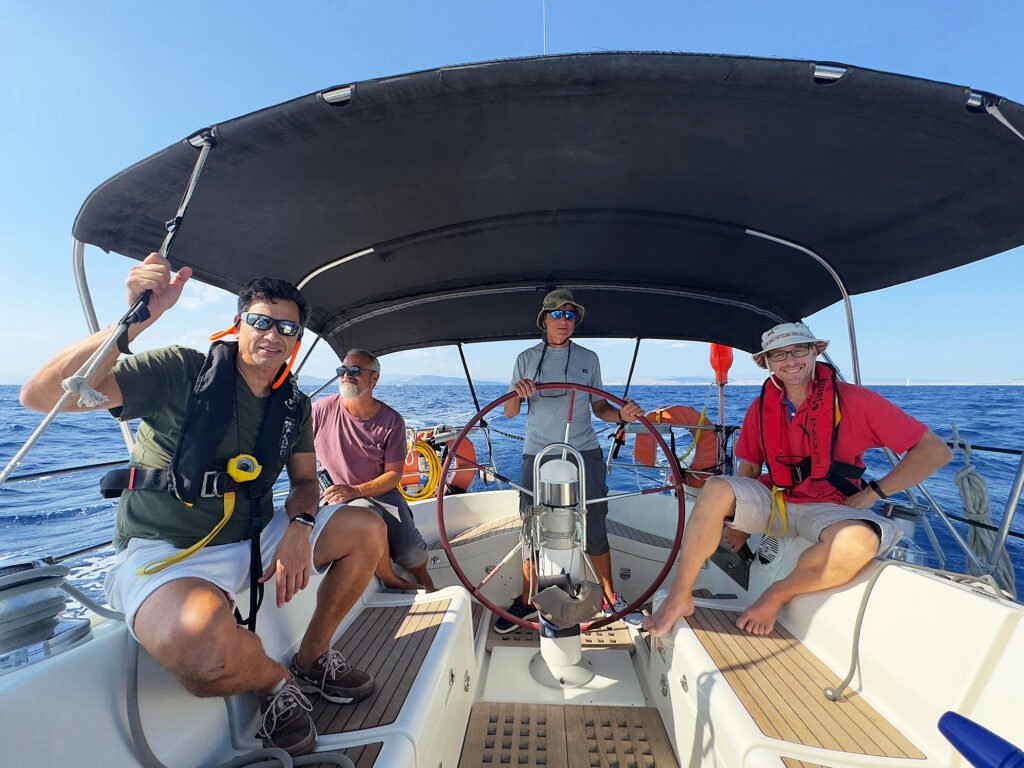
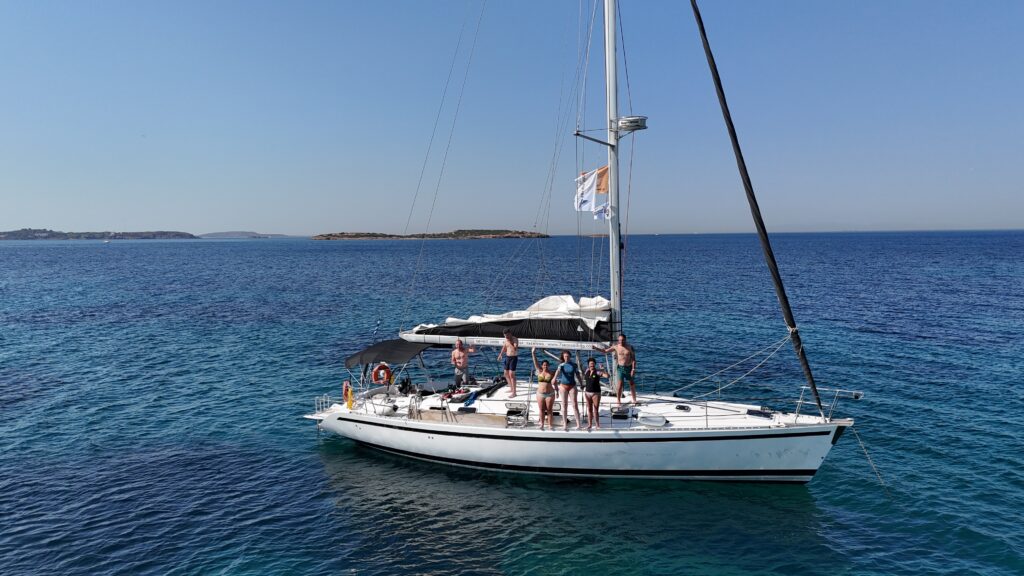
The first hour is about getting settled. You’ll stow your gear in your cabin, get familiar with the layout of the boat, and meet the rest of your group. We keep groups to a maximum of five students per yacht, so it never feels crowded.
You will then have a proper safety and boat briefing with your instructor — not a box-ticking exercise. You’ll learn where everything is: flares, life jackets, fire extinguishers, the bilge pump, the VHF radio. You’ll learn how to get on and off the boat safely, how to move around on deck, and what to do if something goes wrong. At around 12:00pm you should already be departing – we always try to leave as early as possible so that you can make the most ofr your first sailing day.
The first night is typically spent at anchor in a bay near Athens or at a small harbour in the Saronic Gulf or the Cyclades. Dinner is usually taken ashore in small tavernas and restaurants.
Days 2–5 — Into the Islands
This is the heart of the week. Each day follows a rhythm that becomes familiar quickly: an early start, a passage to the next destination, practical skills work underway, and an evening in harbour or at anchor.
The specific route changes depending on weather, wind direction, and course level. The Saronic Gulf — Aegina, Poros, Hydra, Ancient Epidavros — and the Cyclades – Kea, Kythnos, Syros – are our primary sailing areas, with occasional runs further into the Argolic Gulf. Conditions in the Aegean during the sailing season are well-suited to learning: consistent winds (often the Meltemi in summer), clear visibility, and manageable sea states.
What you’re actually doing during the day depends on which course you’re on. On Competent Crew, you’ll rotate through all the crew roles: helming, sail trimming, foredeck work, navigation assistance, and keeping watch. On Day Skipper, you’ll be planning and executing passages yourself, with your instructor watching, questioning, and gradually stepping back. On Coastal Skipper, the instructor steps back further still — you’re expected to run the boat, manage the crew, make tactical decisions in changing conditions, and handle whatever the Aegean throws at you with real independence.
Evenings are the best part. Mooring in a Greek harbour village — stern-to on the quay, as is the local custom — means you’re in the middle of the action. Dinner ashore, a walk through the village, and an early night. You won’t need much convincing: a day of sailing in the sun is a genuine physical workout, and most people sleep very well.
A Typical Day on the Water
There’s no fixed timetable, but most days follow a pattern something like this:
- 07:00 — Wake up. Coffee and making breakfast.
- 08:00 — Breakfast together in the cockpit or saloon. The instructor goes through the day’s passage plan: where you’re heading, the weather forecast, expected wind and sea state.
- 09:00 — Depart. Engine on to leave harbour, then sails up once you’re clear. The helming begins.
- 09:00–14:00 — Passage underway. Everyone rotates through the helm and other duties. Your instructor teaches, demonstrates, corrects, and asks questions. There’s no classroom — the lessons happen on the water, in real conditions.
- 14:00 — Anchor for lunch in a sheltered bay, or continue to the day’s destination. Swimming stop if conditions allow.
- 15:00–18:00 — Afternoon sail, or arrival in harbour and mooring practice.
- 18:00 — Boat tidied, sails stowed, logbook updated. Some time to yourself — shower (marina facilities or on-board), explore the village, or just sit in the cockpit.
- 20:00 — Dinner ashore. Debrief naturally folds into conversation about the day.
- 22:00 — Most people are ready to sleep. On courses with night passages, the watch rota starts instead.
Day 6 — Consolidation
By day six, the group has found its rhythm. Students who arrived nervous about taking the helm are now doing it comfortably. The skills that felt mechanical in the first couple of days — tacking, gybing, picking up a mooring buoy, coming alongside — start to feel natural.
Day six is typically used to consolidate and push further. For Competent Crew students, this often means more independent responsibility at the helm and on deck. For Day Skipper students, it means a longer passage or a more demanding approach — entering a busy harbour, handling a squall, executing a man overboard drill as skipper. For Coastal Skipper students, day six often involves the most challenging sailing of the week: an extended offshore leg, a night passage, or navigating in reduced visibility — the kind of situation where the course stops feeling like training and starts feeling like the real thing.
The return passage toward Athens begins, threading back through the islands with more confidence than you left with.
Day 7 — Return to Alimos and Certificate
The final sailing session is the return to Alimos Marina. You’ll arrive by 13:00-14:00 on Friday afternoon. You’ll berth the boat — probably with more precision than you managed leaving — and spend the last hour going through the end-of-course debrief with your instructor and a member of the admin team.I
The RYA certificate is . Your instructor will also complete your RYA logbook entry, recording the miles sailed and the skills signed off.
Departure is typically early afternoon. Some people head straight to the airport. Others stay on in Athens for a day or two — which, after a week in the islands, feels like a reasonable reward.
What to Pack
Space on a yacht is limited. Pack light, pack soft (hard-sided suitcases are difficult to stow), and focus on layers rather than bulk.
Sailing essentials
- Non-marking, non-slip shoes (closed toe preferred, sneakers will do nicely)
- Waterproof sailing jacket — even in summer, spray and early mornings can be cold
- Sailing gloves (optional but recommended, especially for rope work)
- Sunglasses with UV protection and a retainer strap
- High-factor sunscreen — the Aegean sun reflects off the water
- Sun hat or cap with a brim
- Warm mid-layers (fleece or similar, especially for courses in late autumn and winter) for evening passages and early mornings
Clothing
- 4–5 days of casual clothes (shorts, t-shirts, one light layer for evenings ashore)
- Swimwear — you will swim
- One slightly smarter outfit if you plan to eat at nicer restaurants in port
- Lightweight towel (quick-dry if you have one)
Practical items
- Seasickness medication — bring it even if you think you won’t need it. Scopoderm patches (prescription), Stugeron, or Sea-Bands are all options worth discussing with your pharmacist beforehand.
- A small daypack or dry bag for going ashore
- Any personal medication
- Power bank — charging points on board are limited
Leave at home
- Hard suitcases or large rigid bags
- Hair dryers or high-wattage appliances (the boat’s inverter won’t support them)
- Excessive footwear — two pairs maximum
Practical Things People Often Ask
Do I have my own cabin? Usually not — berths are private, but cabins are typically shared on a same-gender basis. If you prefer more privacy, we also offer a private cabin option, including the possibility of having your own private bathroom. Just let us know when making your inquiry, and we’ll be happy to discuss the available options with you.
What about seasickness? It’s real, and it can happen even to people who’ve been fine on ferries and boats before. The good news is that our itineraries are carefully planned to minimise discomfort, most people find they have their sea legs by the second day, and we’ll be happy to advise you on the best preventative measures to take before your trip.
What’s the food situation? Basic provisions for breakfast and a light lunch are provided on board, giving you the opportunity to prepare your own meals and become familiar with using the galley as part of the sailing experience. Dinner is usually ashore in harbour, which is one of the real pleasures of the week.
How fit do I need to be? No specific fitness level is required. Sailing is not strenuous in the gym sense, but it does involve moving around a boat, hauling on ropes, and being on your feet for long periods. A reasonable baseline of physical mobility is all that’s needed.
Will I get Wi-Fi? Intermittently, in harbour. At sea, connectivity is sometimes limited. Most people find this is one of the quiet pleasures of the week.
Ready to Book, or Still Have Questions?
A liveaboard RYA sailing course in the Aegean is one of those weeks that tends to stay with people. The combination of learning something real, in a beautiful place, with a small group of people who are all in the same boat — literally — creates an experience that’s difficult to replicate.
If you’re ready to look at dates and availability, start here:
- RYA Competent Crew — dates & pricing
- RYA Day Skipper Sail — dates & pricing
- RYA Coastal Skipper Sail — dates & pricing
If you’d like to talk it through first — what level to start at, what the week is really like, or anything else — book a free 1:1 call with one of our team members. Twenty minutes is usually all it takes.