The RYA — Royal Yachting Association — runs the most widely recognised system of sailing qualifications in the world. Its certificates are accepted by charter companies, maritime authorities, and sailing clubs across Europe, the Mediterranean, and beyond. If you want a training and qualification that actually means something on the water, the RYA pathway is where most sailors start.
Greece is one of the finest places to earn those qualifications. The Aegean offers reliable winds, sheltered island passages, real seamanship challenges, and the kind of sailing environment that simply does not exist in northern European waters. This guide covers every step of the RYA sailing pathway — what each qualification involves, what it allows you to do, and how to progress from complete beginner to confident, certificated skipper.
How the RYA Pathway Works
The RYA system is progressive. Each qualification builds directly on the one before it, and there are no shortcuts — but there is also no unnecessary complexity. The pathway for recreational sailors has four main practical stages, each paired with a shorebased theory component at the appropriate level.
You do not need to complete every stage. Many sailors reach Day Skipper and stop there — it is the qualification that most charter companies require and most recreational sailors need. Others continue to Coastal Skipper or Yachtmaster because they want to sail longer passages, skipper professionally, or simply because they enjoy the challenge of becoming a better sailor.
The pathway looks like this:
- RYA Competent Crew — your introduction to sailing as a crew member
- RYA Day Skipper — your first command qualification, for coastal passages by day
- RYA Coastal Skipper — extended passages, night sailing, and more demanding conditions
- RYA Yachtmaster — the benchmark of competence for serious offshore sailing
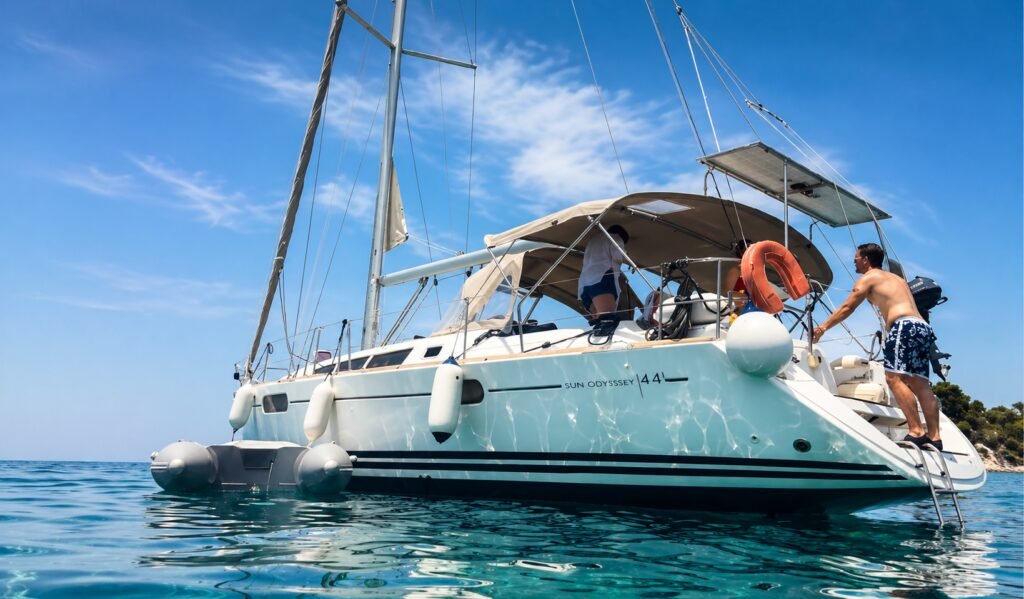
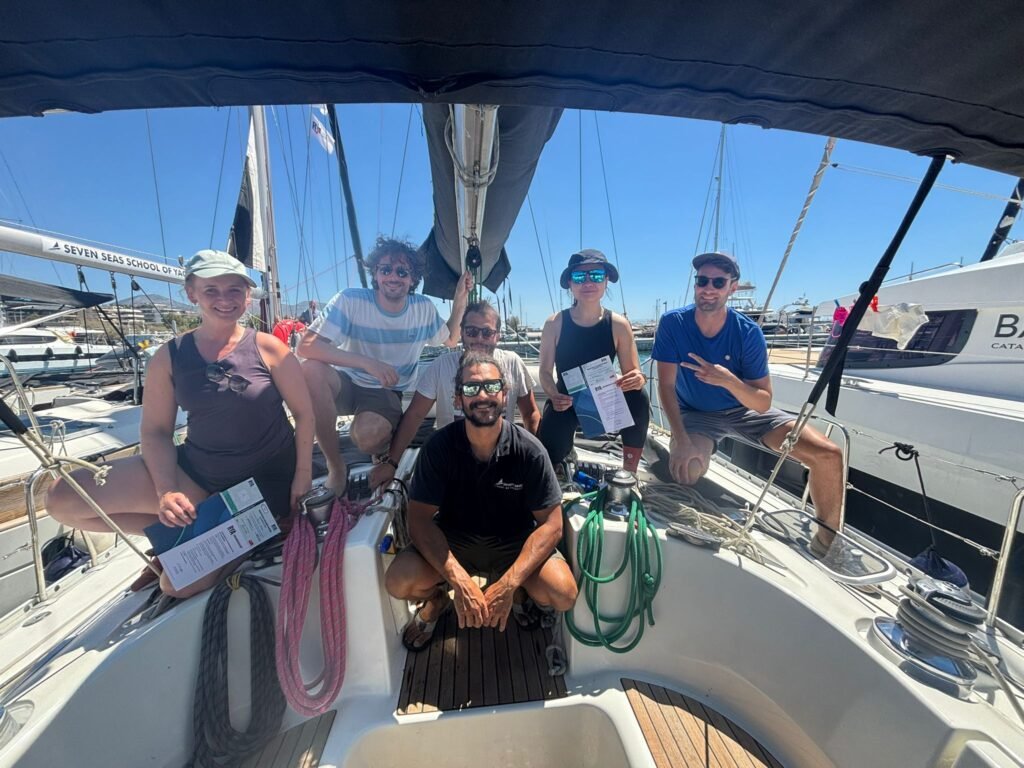
Each practical course is run as a liveaboard week in the Saronic Gulf or the Cyclades, operating from Alimos Marina in Athens. Groups at Seven Seas are capped at five students per yacht — which means real time at the helm, not observer hours.
Stage 1: RYA Competent Crew
Who it is for
The RYA Competent Crew course is designed for people with little or no sailing experience. You do not need to have been on a sailing yacht before. The course starts from the beginning and treats that as a given.
What you will learn
Over seven days liveaboard in the Greek islands, you will learn how a sailing yacht works and how to be a useful, safe, and competent crew member. That means helming, sail handling, rope work, anchoring, watchkeeping, man overboard procedures, and living and working as part of a crew at sea. There is no theory exam and no written test — assessment is continuous and practical throughout the week.
What it qualifies you to do
The Competent Crew certificate confirms that you can crew a yacht safely. It does not qualify you to skipper — that comes next. But it is a genuine and recognised starting point, and many charter companies and sailing clubs will accept it as evidence of basic competence when joining as crew.
Theory requirement
None. Turn up ready to learn and get involved.
Typical next step
RYA Day Skipper practical — either immediately after, or once you have built additional sea miles through crewing.
Stage 2: RYA Day Skipper
Who it is for
The RYA Day Skipper practical is for sailors who have a basic grounding in sailing — either from a Competent Crew course, from dinghy sailing, or from time crewing on yachts — and are ready to take command of their own boat.
What you will learn
The Day Skipper practical week puts you in the skipper’s seat. You will plan and execute passages, navigate using charts and instruments, manage your crew, make decisions under pressure, berth in unfamiliar harbours, and handle emergency situations as the person in charge. The course includes at least one overnight passage. Your instructor observes, guides, and challenges — but the responsibility increasingly falls on you as the week progresses.
What it qualifies you to do
The Day Skipper certificate qualifies you to skipper a yacht on short coastal passages in familiar waters, by day. In practical terms, it is the qualification that most bareboat charter companies require for independent charter in the Mediterranean. It is the most important single step on the RYA ladder for the majority of recreational sailors.
Theory requirement
The RYA recommends completing the Day Skipper Shorebased Theory course before the practical. This is available online and covers chart work, navigation, tides, meteorology, and the Collision Regulations. You do not need to have sat the exam before arriving, but familiarity with the material will significantly improve your practical week.
Typical next step
Many sailors stop here. Those who want to extend their range — longer passages, night sailing, less familiar waters — move on to Coastal Skipper.
Stage 3: RYA Coastal Skipper
Who it is for
The RYA Coastal Skipper practical is for experienced Day Skipper-level sailors who are ready to push further. You should be comfortable skippering in familiar conditions and looking to extend your capability to longer passages, more demanding weather, and offshore sailing.
What you will learn
The Coastal Skipper week operates at a significantly higher level than Day Skipper. You will plan and execute extended passages, including overnight and potentially multi-day legs. You will navigate in more challenging conditions, manage watch systems for offshore sailing, and handle situations — squalls, equipment failures, navigational complexity — where the margin for error is smaller. The instructor is present but increasingly in the background. By the end of the week, you should be making decisions independently and confidently.
What it qualifies you to do
The Coastal Skipper certificate qualifies you to skipper a yacht on coastal and offshore passages, by day and by night. It is recognised by charter companies operating in more demanding sailing areas and is a prerequisite for the RYA Yachtmaster examination.
Theory requirement
The Coastal Skipper / Yachtmaster Offshore Shorebased Theory course is the required companion to this practical. It covers advanced navigation, passage planning, meteorology, and offshore seamanship to a higher standard than Day Skipper theory. Complete or be well into this course before joining the practical week.
Typical next step
For those pursuing the full pathway — particularly sailors with professional ambitions or plans for extended offshore passages — the next step is the RYA Yachtmaster examination.
Stage 4: RYA Yachtmaster
Who it is for
The RYA Yachtmaster is not a course in the traditional sense — it is an examination. To sit it, you must meet minimum sea time requirements set by the RYA: at least 2,500 nautical miles logged, including 5 passages of over 60 miles, time as skipper, and night hours at sea. The examination itself is conducted by an independent RYA examiner over approximately 8–10 hours on the water.
What it qualifies you to do
The RYA Yachtmaster Coastal certificate is the benchmark qualification for skippering a yacht on any coastal or offshore passage. The Yachtmaster Offshore extends that recognition to open ocean passages. Both are recognised internationally as the highest standard of recreational and semi-professional sailing competence, and the Yachtmaster Offshore is required for many professional skippering roles on yachts up to 200GT.
Preparation
Seven Seas offers Yachtmaster preparation courses and mile-building passages in the Aegean for sailors working toward the required sea time. If Yachtmaster is your goal, talk to us early — the miles and hours accumulate faster when you have a plan.
Why Train in Greece?
The RYA pathway can be completed at accredited training centres across the UK, Europe, and the Caribbean. So why choose Greece?
The sailing conditions are genuinely good. The Saronic Gulf and Cyclades offer reliable seasonal winds, a mix of open passages and sheltered anchorages, and conditions that range from benign to genuinely challenging depending on the time of year. You will encounter real navigation decisions, real seamanship situations, and real weather — not a sheltered harbour circuit.
The environment accelerates learning. Liveaboard training in the Greek islands means you are sailing and living on the boat for seven consecutive days. That level of immersion produces faster, more durable learning than day-sailing courses where you go home each evening and lose continuity. By the middle of the week, the routines of boat handling and watchkeeping have become instinctive.
The geography is ideal for the pathway. The Saronic and Cycladic islands provide a natural training circuit: island passages of 15–20 nautical miles, working harbours with stern-to berthing, varied anchorages, and the Meltemi wind system that gives students a proper introduction to Mediterranean sailing. For Coastal Skipper students, the routes extend further south and east, into genuinely offshore conditions.
The context makes the qualification meaningful. Earning your Day Skipper certificate in the same waters where you intend to charter is not a coincidence — it is the point. Students who train in Greece leave with local knowledge, confidence in Mediterranean conditions, and a direct line to the experience they were training for.
What RYA Qualifications Allow You to Charter in Greece
Greece requires charter operators to verify skipper competence before releasing a bareboat yacht. In practice, most reputable charter companies in Greece accept the following as a minimum for bareboat charter:
- RYA Day Skipper — accepted for yachts up to approximately 10–15 metres in the Saronic and Ionian
- RYA Coastal Skipper — accepted for larger yachts and more exposed sailing areas
- RYA Yachtmaster — accepted universally, including for commercial and professional contexts
The Greek coast guard may also require an International Certificate of Competence (ICC), which can be issued alongside RYA qualifications. We can advise on this when you book.
Where to Start
If you are reading this as a complete beginner, start with Competent Crew. If you have some sailing experience and want to reach Day Skipper level, we can assess whether you can join directly at that level — book a free call and we will give you an honest answer based on your background.
If you already hold a Day Skipper and are thinking about Coastal Skipper or Yachtmaster, talk to us about the right preparation and timing. The progression is straightforward when you have a clear plan.
- RYA Competent Crew — dates & pricing
- RYA Day Skipper Sail — dates & pricing
- RYA Coastal Skipper Sail — dates & pricing
- RYA Yachtmaster — preparation & examination
Or book a free 1:1 call with a member of our team. Twenty minutes is usually all it takes to map out the right path.