The Saronic Gulf sits on the doorstep of Athens, and for anyone learning to sail in Greece, it is the natural starting point. Within a short passage of Alimos Marina you are island-hopping between Aegina, Poros, Hydra, and Spetses — each with its own character, its own harbour, and its own reason to stay a night longer than planned.
We have been running liveaboard sailing courses in the Saronic for over a decade. What follows is what we tell our students before they arrive: the shape of the gulf, the winds to expect, the anchorages worth knowing, and the practical realities of sailing this stretch of water for the first time.
The Shape of the Saronic Gulf
The Saronic Gulf stretches roughly 80 nautical miles from the northern tip near Piraeus down to the island of Spetses in the south, with the Peloponnese coastline forming its western boundary and Attica to the north and east. It is not an open sea crossing — it is a sheltered inland body of water, broken up by islands that offer natural protection and an almost endless choice of anchorages and harbours.
For a first-time skipper, this geography is ideal. You are rarely more than a couple of hours from shelter. Passages between islands are short enough to complete comfortably in a morning, leaving the afternoon free for anchoring, swimming, and exploring. The distances between key stops give a sense of the scale:
- Alimos Marina to Aegina town: approximately 18nm (3–4 hours under sail)
- Aegina to Poros: approximately 20nm
- Poros to Hydra: approximately 18nm
- Hydra to Spetses: approximately 18nm
- Spetses back to Alimos (direct): approximately 55nm — typically an overnight or early-start passage
A seven-day course starting and ending at Alimos will typically complete a loop of all four main islands, with variations depending on wind and weather.
Wind and Weather: What to Expect
The Saronic has a well-defined seasonal pattern that makes it genuinely beginner-friendly for much of the year.
May and June offer some of the best sailing conditions anywhere in the Mediterranean: warm, stable weather, winds of 10–18 knots from the north or northwest, and long daylight hours. Seas are generally calm and the anchorages are not yet crowded. For first-time crew and new skippers, this is the ideal window.
July and August bring the Meltemi — the prevailing summer wind that funnels down from the north. In the Saronic it is less fierce than in the open Aegean or the Cyclades, but it can still build to 20–25 knots on exposed stretches, particularly in the afternoons. It is a consistent, predictable wind that experienced sailors relish and beginners learn to respect. The key is timing: leave early in the morning before it builds, and be in harbour or at anchor by early afternoon.
September and October are arguably the most pleasant months to sail in Greece. The Meltemi eases, temperatures remain warm, the sea is at its warmest for swimming, and the tourist crowds thin out noticeably. Wind patterns become more variable, which makes for more interesting sailing and better training conditions for students working toward Day Skipper or Coastal Skipper level.
What you will not encounter in the Saronic during the main sailing season: fog, significant tidal range (the Mediterranean is essentially tideless), or dramatic ocean swell. These are conditions for other waters. The Saronic’s challenges are its own — afternoon sea breezes, ferry wash in busy channels, and the occasional squall in shoulder-season months — but they are manageable and instructive rather than dangerous.
The Islands: A Skipper’s Notes
Aegina
Aegina is the first island most courses reach after leaving Alimos, and it earns its place on every itinerary. Aegina town has a busy, working harbour with stern-to berthing along the main quay — good practice for new skippers, with ferries and hydrofoils to keep you honest. Provisioning is straightforward: the market runs along the waterfront and the tavernas are reliable.
For a quieter overnight, the bay of Perdika on the island’s southwest tip offers good holding in sand, a small fishing village, and one of the better views in the Saronic at sunset. The anchorage at Souvala on the north coast is more sheltered in southerlies but less characterful.
Poros
The channel between Poros and the Peloponnese mainland is one of the more dramatic pieces of water in the Saronic — narrow, busy with ferries and local traffic, and lined with cafés on both sides. Berthing in Poros town puts you in the middle of it, which is either appealing or overwhelming depending on the time of year. In July and August, arrive early or expect to raft up.
The anchorage of Monastery Bay (Zoodochos Pigi) on the island’s eastern side is a favourite for courses: well-sheltered, peaceful, and close to a working monastery accessible by a short walk through pine forest. Good holding in sand and weed, 4–8 metres.
Hydra
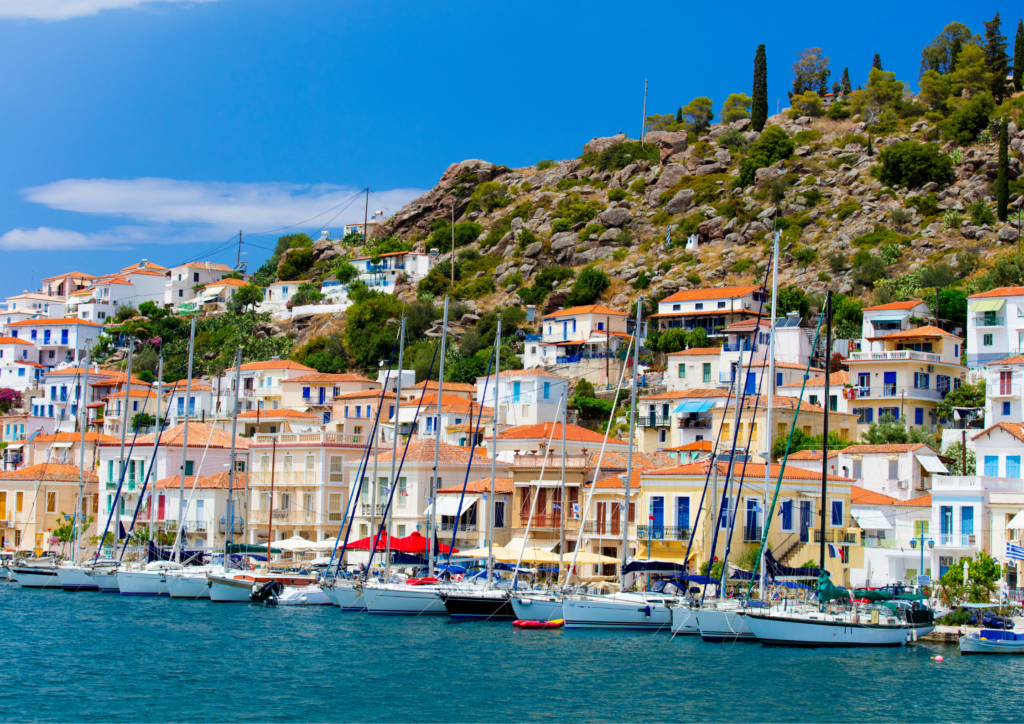
Hydra is the one island in the Saronic that needs no introduction and fully justifies its reputation. No cars, no mopeds — just the harbour, the stone houses climbing the hillside, and the water. The main harbour is deep and exposed to the wash from passing vessels; berth stern-to on the town quay or pick up one of the buoys in the outer harbour. Space goes fast in high season.
For anchoring, the bay of Mandraki on the northeast coast offers good shelter from the prevailing northerlies and a quieter alternative to the town. The passage between Hydra and the islet of Dokos to the west is worth sailing in settled conditions — clean water, minimal traffic, and a good anchorage at Dokos bay if you want to be completely alone.
Spetses
Spetses marks the southern extent of most Saronic itineraries and has a slightly different feel to the other islands — broader, greener, with a longer promenade and a more relaxed pace. The old harbour (Palio Limani) is the most characterful berth, though it is tight. The new harbour (Dapia) has more space and better facilities.
The anchorage at Zogeria Bay on the island’s north coast is one of the most beautiful in the entire Saronic: a pine-lined cove in clear water with good holding and very little boat traffic. Worth a lunch stop or overnight even if the passage adds an hour to your day.
Practical Notes for First-Time Skippers
Berthing. The Mediterranean moor — engine astern, anchor down, stern lines to the quay — is the standard throughout the Saronic. If you have not done it before, it is one of the key skills you will develop on a training course. It looks intimidating; it becomes second nature within a few days.
Ferry traffic. The Flying Dolphin hydrofoils and conventional ferries that connect the islands to Piraeus move fast and do not deviate. In busy channels — particularly the Poros strait — stay to the right, keep a proper lookout, and give them room. This is not the place to be complacent on watch.
Fuel and water. Both are available at most main harbours. Aegina, Poros, Hydra, and Spetses all have fuel docks or jerry-can arrangements. Water points are common on the main quays. Fill up whenever you have the opportunity — smaller anchorages have neither.
Anchoring etiquette. The Saronic anchorages fill up quickly in July and August. Arrive early, give your neighbours enough swinging room, and use a trip line if you are anchoring over a rocky bottom. Holding is generally good in sand, variable over weed. Always check that your anchor is set before going ashore.
Charts. The Imray G13 (Saronic Gulf) is the standard chart for this area and is available in Athens before you depart. All Seven Seas yachts carry up-to-date electronic charts and paper backups. Students on Day Skipper and Coastal Skipper courses will work with both.
Is the Saronic the Right Place to Learn?
For the vast majority of people taking their first RYA course, yes — without much hesitation. The combination of sheltered waters, short passages, reliable winds, and accessible harbours creates a learning environment that is genuinely forgiving without being dull. You get real sailing, real navigation decisions, and real seamanship situations, in a place where the consequences of a mistake are manageable and the support is close at hand.
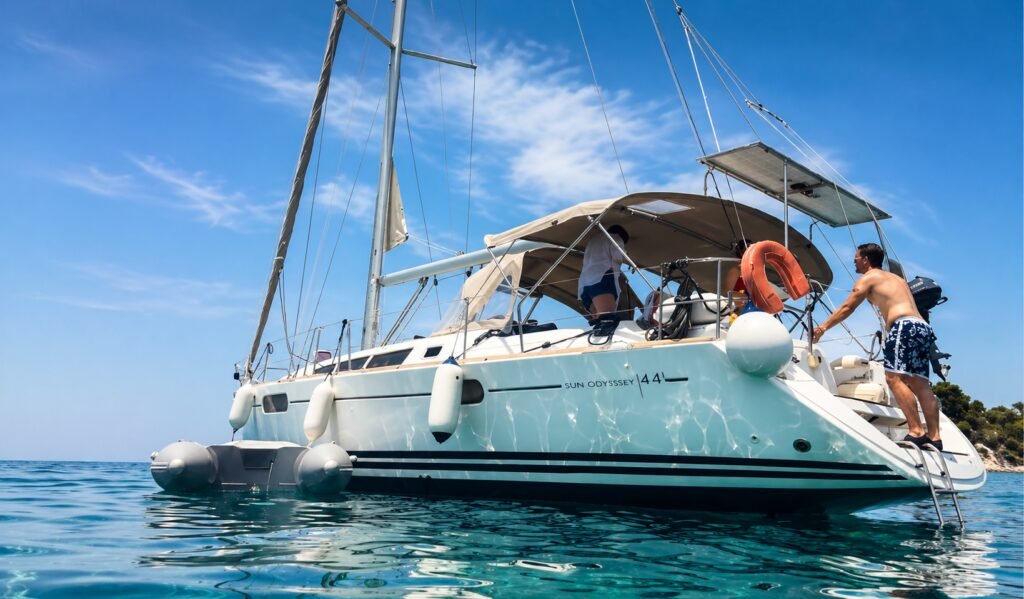
The islands themselves make it easier to commit to the week. Waking up at anchor in a Saronic bay, swimming off the back of the boat before breakfast, and eating fresh fish in a harbour village in the evening — these are not incidental to the course. They are part of what makes the experience stick.
Sail the Saronic With Us
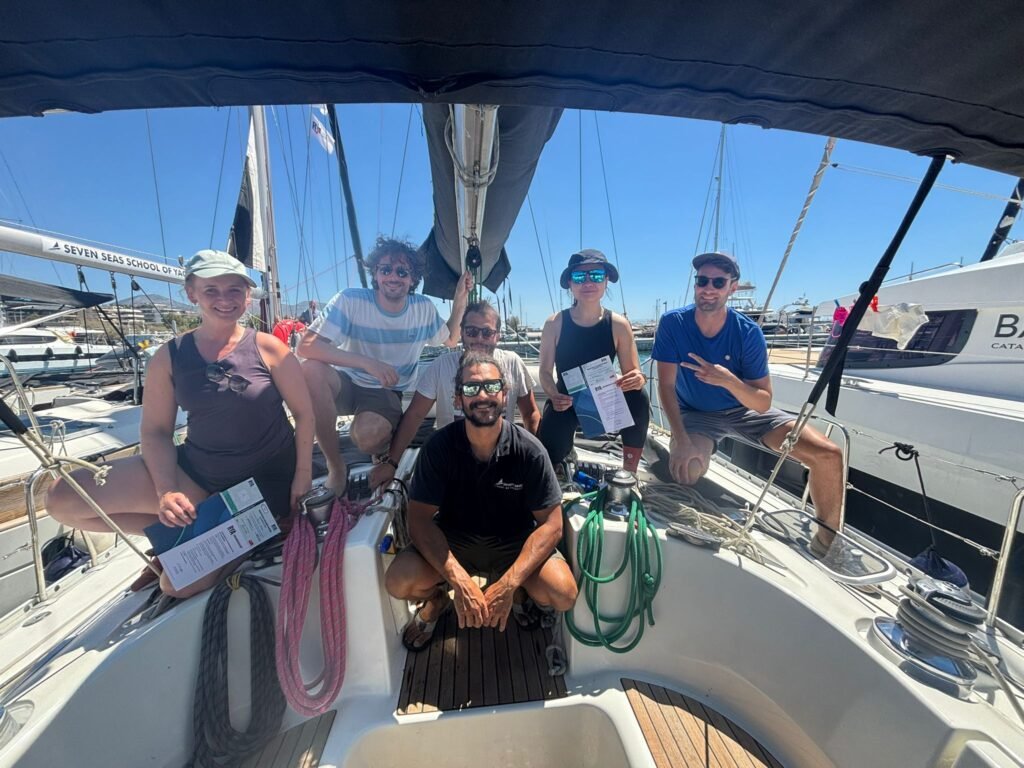
All Seven Seas liveaboard courses operate in the Saronic Gulf and wider Aegean, departing from Alimos Marina in Athens. Groups are kept to a maximum of five students per yacht, and every course is led by a qualified RYA instructor with extensive local knowledge.
If you are considering your first sailing course — or your next qualification — start here:
- RYA Competent Crew — for complete beginners
- RYA Day Skipper — your first command qualification
- RYA Coastal Skipper — for experienced sailors ready to go further
Or if you would like to talk through which course suits you, book a free 1:1 call with one of our instructors. We know these waters well, and we are happy to share what we know before you commit to anything.