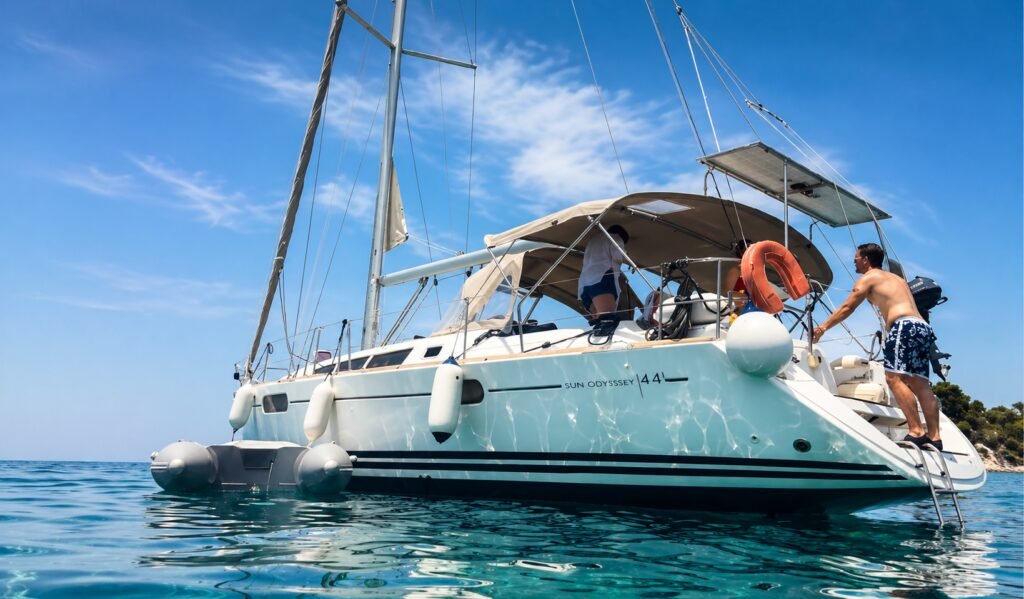
If you are already working on the water — skippering charter yachts, leading flotillas, crewing commercially, or delivering boats — you have almost certainly accumulated more relevant sea time than most RYA candidates ever will. What you may not have is the certificate that formally recognises it.
The RYA Yachtmaster Coastal and Offshore are the qualifications that match what you already do. They are globally recognised, required for MCA commercial endorsements, and increasingly the baseline expectation among charter companies and superyacht operators. The question most working skippers ask is not whether to do it — it is how long it will actually take from where they already are.
Here is an honest answer.
The Prerequisites: What the Exam Requires
The Yachtmaster is an examination conducted by an independent RYA examiner — not a course you complete by attending. Before you can sit it, you must meet the following minimum thresholds:
RYA Yachtmaster Coastal
- 30 days at sea
- 2 days as skipper
- 800 nautical miles
- 12 night hours
- Minimum age: 17 at the time of the exam
RYA Yachtmaster Offshore
- 50 days at sea
- 2,500 nautical miles
- 5 passages of over 60nm — at least 2 as skipper, at least 2 overnight
- Minimum age: 18 at the time of the exam
An important note on tidal waters: half of the required sea time for either level must be in tidal waters. The Mediterranean, Black, Red, and Baltic Seas do not count as tidal for this purpose. If the bulk of your experience is in the Mediterranean, this is the prerequisite that most often requires planning. Speak to us early so we can help you work out whether you meet the threshold or need to supplement your sea time.
On proving your sea time: you do not need an official logbook. As part of enrolment in the programme, candidates complete and sign a sea time declaration form, reconstructing the passages they have completed. Official logs or statements are not required, though it is useful to have any records to hand in case the examiner asks for further detail during the exam itself.
You will also need to hold a GMDSS-compliant Marine Radio Operator’s Certificate and a valid RYA-approved First Aid Certificate before sitting the exam. Both are included as part of the Seven Seas Preparation Programme, so if you do not already hold them, they are taken care of within the programme itself.
The Preparation Programme: More Than Exam Technique
This is where most accounts of the Yachtmaster journey stop short. The prerequisite checklist is the entry ticket — the preparation programme is where the real work happens, and where Seven Seas invests significantly more than the RYA minimum requires.
The Seven Seas Yachtmaster Preparation Programme is not a cramming course. It is designed as an important step in developing the judgement, seamanship, and professional standards expected of a Yachtmaster — not simply as a means to pass an exam. For working skippers, that distinction matters. The programme takes what you have been doing on the water and brings it to examination standard: formalised, documented, technically precise, and defensible under an examiner’s questioning.
The programme is structured in three stages:
Practical Session 1 — Assessment Under Real Conditions
Before theory begins, candidates go out on the exam boat under conditions similar to the actual test. This is not a warm-up — it is a diagnostic. The session identifies where each candidate genuinely needs work: not in a general sense, but specifically and individually. For a working skipper, the gaps are rarely in boat handling. They are more often in formal passage planning, the structured debrief, or the precise execution of manoeuvres to examination standard rather than working practice.
Theoretical Preparation — 65+ Hours
The theoretical component goes well beyond what a self-study candidate would cover. Topics include advanced position fixing, course shaping and plotting, tidal knowledge, use of almanacs and admiralty publications, electronic navigation equipment, weather systems and barometric forecasting, radar, stability, and the anatomy of maritime accidents.
The programme also includes the RYA GMDSS SRC course and exam (for candidates who do not already hold it), and the RYA-approved First Aid/CPR certificate issued by the Hellenic Lifeguard Academy.
After the theoretical component, candidates sit an internal theory exam. Passing it is a prerequisite for moving to the final practical session and the Yachtmaster examination itself.
Practical Session 2 — Examination Preparation
The five-day practical session following theory focuses on the exam boat and the specific manoeuvres and scenarios RYA examiners require. This covers commanding skills, close-quarters manoeuvres under sail and motor, pilotage, passage planning to examination format, crew management, overnight passages, man overboard recovery, and overall exam preparation.
For working skippers, this session is where the translation happens — from the fluid, experience-based competence developed on the job, to the structured, demonstrable performance an examiner needs to see.
The Examination Itself
The Yachtmaster exam is conducted by an independent RYA examiner over approximately 8–10 hours on the water, covering passage planning, pilotage, sail and engine handling, collision regulations in real situations, man overboard recovery, emergency procedures, and an oral assessment of meteorology, seamanship, and the responsibilities of a skipper.
Working skippers consistently find the practical elements of the exam familiar. The areas that require the most specific preparation are the formal written passage plan — which has a precise RYA format — and the oral examination, which probes regulatory and meteorological knowledge to a higher standard than most working skippers have studied formally.
The exam is conducted in English. A good level of fluency is required.
How Long Does the Whole Process Take?
The Seven Seas Yachtmaster Preparation Programme, including the exam, typically takes around 1.5 months from start to certificate. Candidates need to be available in Athens for the full duration, as practical sessions are scheduled around weather conditions and may be confirmed at short notice.
For working skippers whose sea time prerequisites are already met, the path is essentially: enrol, complete the programme, sit the exam. The 1.5-month timeline is realistic and achievable without needing to accumulate additional sea miles first.
The variable that most often extends the timeline is the tidal waters requirement. If your experience is predominantly Mediterranean, you will need a plan for building tidal sea time before you can sit the Offshore exam. Talk to us about this before you book — it is a solvable problem, and the earlier it is identified the better.
What the Certificate Opens Up
The RYA Yachtmaster Offshore is the gateway to MCA commercial endorsements, which allow you to skipper vessels for hire up to 200GT. Without it, those endorsements are unavailable. For skippers working on charter yachts, superyachts, or commercial sailing vessels at any level above the most basic, this is increasingly a baseline requirement rather than an optional credential.
Charter companies and yacht management firms operating at the higher end of the market specify the Yachtmaster Offshore explicitly. It is the entry point to that tier — and for a working skipper, it is the qualification that formally closes the gap between what you do and what your CV says you can do.
Ready to Work Out Where You Stand?
The fastest route to your Yachtmaster depends on where your sea time sits and whether the tidal waters threshold is met. A short call with one of our instructors — will give you a clear picture of exactly what you need and in what order.