Renting a speedboat and exploring the Greek coastline on your own terms is one of those experiences that sounds straightforward until you are actually at the helm — navigating a busy harbour, picking up a mooring in a swell, or dealing with the wash from a passing ferry. Greece attracts a huge number of people who want exactly that kind of freedom on the water. The ones who enjoy it most are the ones who know what they are doing.
The RYA Powerboat Level 2 is two days of practical instruction that gives you exactly that — not a piece of paper to satisfy a rental company, but the actual skills to handle a powerboat confidently in real conditions. Most people who complete it say the same thing: they wish they had done it sooner.
No prior experience needed. Here is what the course involves.
What the Course Is Actually About
The RYA Powerboat Level 2 is a practical course — almost entirely on the water, almost entirely hands-on. It is not about memorising rules or sitting through presentations. It is about developing feel: for the throttle, for the way the boat responds in different conditions, for the judgement calls that separate a competent driver from an anxious one.
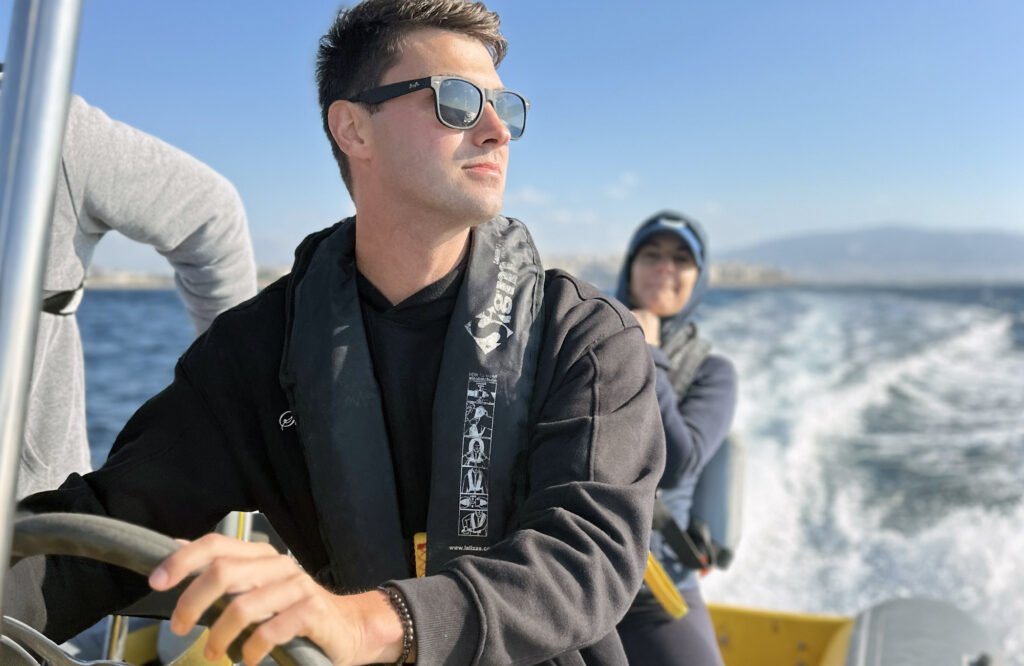
The course runs out of Tzitzifies Marina in Kallithea, Athens, on a Tornado 6.40m with an Suzuki 250hp engine — a proper, responsive powerboat that gives you a genuine sense of what boat handling at speed requires. Groups are capped at four participants, which means significant time at the helm for everyone, not an hour of steering while three others watch.
What You Will Learn
Slow-speed handling — the foundation of everything
The first thing most new powerboat drivers discover is that slow is harder than fast. Manoeuvring in a confined space — a marina, a mooring field, alongside a quay — requires precise throttle and steering control that takes practice to develop. The course starts here, deliberately. Coming alongside cleanly, turning in tight spaces, holding position in a crosswind: these are the skills that matter every single time you use a boat, and the ones that separate drivers who look like they know what they are doing from those who don’t.
High-speed handling
Once the slow-speed fundamentals are in place, the course moves to planing speed. How the boat behaves differently at speed, how to read the sea state and adjust, how to handle wash from other vessels, how to make course corrections smoothly and safely. The Aegean in summer is not an empty lake — there is traffic, there is chop, and there are situations that require good instincts. The course builds those instincts deliberately.
Man overboard recovery
This is the drill that every powerboat driver should be able to execute without thinking. It is also the one that most people without formal training have never practised. The Level 2 covers man overboard recovery under instruction until it becomes automatic — the right approach angle, the right speed, the right moment to cut the engine. It is one of those things you hope never to need and would be very glad to know if you did.
Anchoring and mooring
Finding a bay, reading the bottom, setting the anchor correctly, picking up a mooring buoy without drama — these are the practical skills that make a day on the water enjoyable rather than stressful. The course covers all of them on the water, not on a whiteboard.
Navigation and passage planning
Basic chart reading, planning a route, understanding where you are and where you are going. Not to examination standard — this is a practical course, not a theory one — but enough to operate confidently and make sensible decisions when conditions or plans change.
Collision regulations and safety
Who gives way to whom, what the lights and shapes mean, what the safety equipment on board is for and how to use it. The knowledge that keeps you and everyone around you out of trouble.
How the Two Days Are Structured
Day 1 begins with a thorough boat briefing — layout, systems, safety equipment, engine controls — before moving onto the water. The emphasis is on slow-speed handling from the start: leaving and returning to the berth, coming alongside, turning in confined spaces. You will also cover anchoring, mooring, collision regulations, and the basics of passage planning. The first day builds the platform that everything else sits on.
Day 2 extends into higher speeds, more complex scenarios, and the situations that require quicker decision-making: handling in a chop, managing wash from ferries and other traffic, man overboard drills repeated until they are clean. The assessment runs throughout both days — your instructor observes continuously rather than setting a formal test at the end. What they are looking for is consistent, safe, competent handling across a range of real conditions.
Who the Course Is For
The Level 2 works for a wide range of people. What they share is wanting to be genuinely capable on a powerboat, not just approximately familiar with one.
Complete beginners who want a proper foundation from the start — the right habits, the right instincts, built correctly from day one rather than improvised over years.
People with some experience who have driven boats before but never formally trained. Often the most motivated students, because they arrive knowing exactly which gaps they want to fill.
Yacht owners and crew who spend most of their time on sailing yachts but want to be properly competent on a powerboat — particularly relevant for anyone who operates a tender, which requires a specific set of skills that the Level 2 covers thoroughly.
Anyone planning to rent a boat in Greece — not because the certificate is the goal, but because two days of proper instruction makes the difference between a day on the water that is enjoyable and one that is stressful. Knowing what you are doing changes the experience completely.
What Comes Next
The Level 2 qualifies you to handle a powerboat up to 10 metres in daylight in familiar coastal waters. For most recreational powerboaters in Greece, that covers everything they want to do.
If you want to go further — larger vessels, night passages, extended coastal cruising — the RYA Intermediate Powerboat course builds directly on the Level 2 foundation and takes your capability significantly further.
The Level 2 certificate also qualifies you to apply to the RYA for an International Certificate of Competence (ICC) with a Power up to 10m endorsement, without any additional assessment. Worth having if you plan to rent boats regularly across the Mediterranean.
Come and Learn Properly
Two days of good instruction on the water in Athens is a worthwhile investment in how you spend your time on the water for the rest of your life. If you have questions about whether the Level 2 is the right starting point for you, or want to talk through what the course involves, book a free call with one of our experts.