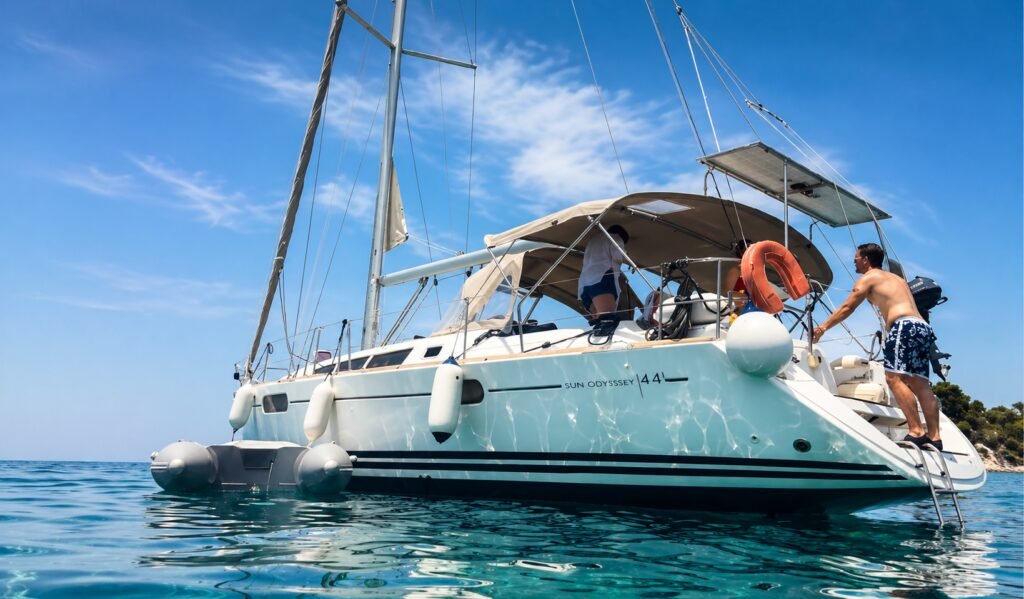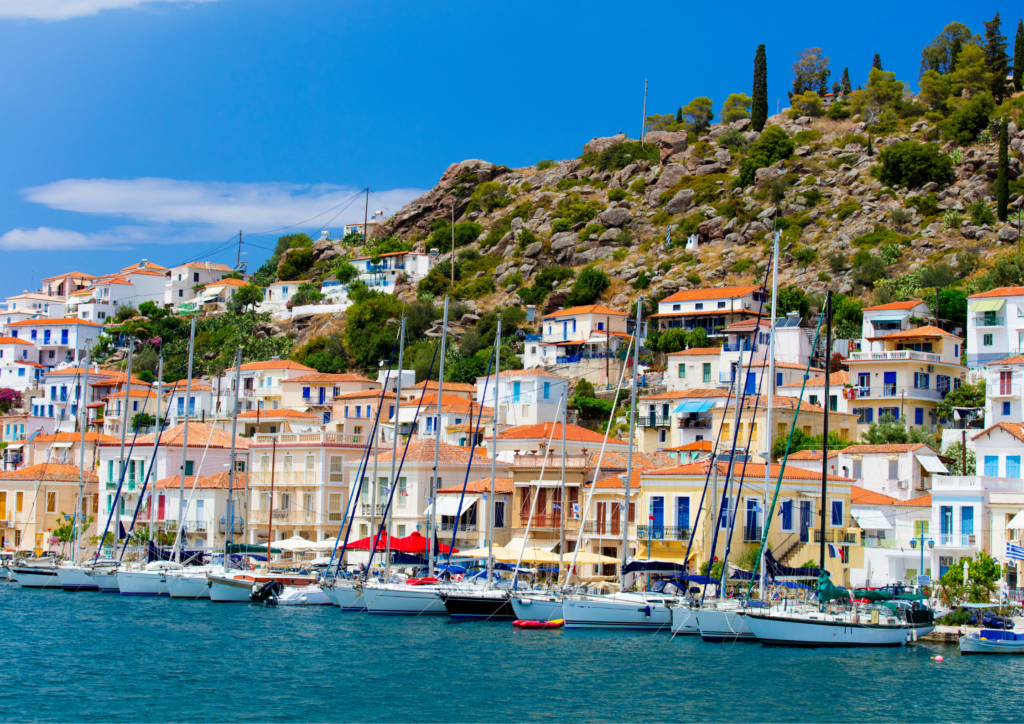
The Cyclades are what most people picture when they think of sailing in Greece: whitewashed villages on clifftops, vivid blue water, volcanic islands rising sharply from the sea, and a wind that arrives reliably every summer and makes the passages fast and memorable. They are also, for the same reasons, some of the most demanding sailing waters in the Aegean — exposed, tidal-free but strongly influenced by the Meltemi, and unforgiving of poor passage planning.
This is a practical guide for skippers who are planning a Cyclades passage — from Athens or from within the islands themselves. It covers the routes, the winds, the anchorages worth knowing, and the realities that sailing guides sometimes gloss over.
Getting There: From Athens to the Cyclades
Most passages into the northern Cyclades begin at Alimos Marina or Piraeus and cross the open water between the Saronic Gulf and the island group. The first island most routes reach is Kea (Tzia) — approximately 42 nautical miles from Alimos, a straightforward day passage in settled conditions — or Kythnos, slightly further south at around 55nm.
The crossing from the Saronic to the Cyclades is the transition point that separates Saronic sailing from Cyclades sailing. The water opens up, the land protection disappears, and the Meltemi — if it is blowing — hits you properly for the first time. In settled conditions the crossing is benign. In a developed Meltemi it requires planning: the standard advice is to leave Alimos at first light, be past Cape Sounion before the wind builds in the late morning, and time your arrival at Kea or Kythnos for early afternoon before conditions deteriorate.
Plan the passage with the Meltemi in mind every time, regardless of the morning forecast.
The Meltemi: What It Is and What It Means for Your Passage Planning
The Meltemi is the dominant feature of Cyclades sailing from late June through to mid-September. It is a dry, northerly wind generated by a pressure system over the Balkans and the thermal gradient between the Anatolian plateau and the Aegean Sea. It blows from the north or northwest, typically building through the morning, reaching its peak between early and late afternoon, and easing in the evening. On bad days it does not ease at all.
In the Cyclades it blows harder and more consistently than in the Saronic. Force 4 to 5 is the everyday baseline in July and August. Force 6 is common. Force 7 is not unusual during a developed system and can last for several days without significant let-up.
What this means in practice:
- Northbound passages are hard work in July and August. Beating into a Force 5 to 6 Meltemi between islands is exhausting and slow. Plan to make northing either in May, June, or September, or accept motor-sailing into it.
- Southbound passages are fast and exhilarating — sometimes more than anticipated. A Force 5 to 6 on the beam or quarter between Mykonos and Paros is an outstanding sail. A Force 7 on the same passage requires respect.
- East-west passages are the most variable — the Meltemi channels between islands and accelerates in straits, so conditions between islands can differ significantly from the open water forecast.
- Timing is everything. Leave early. The Meltemi rarely blows hard before 09:00 and often eases after 18:00. Most experienced Cyclades skippers plan their day around that window.
Key Islands and What to Expect
Syros — The Working Capital
Syros is the administrative capital of the Cyclades and the least typical of the island group — which is precisely what makes it interesting. Ermoupoli, the main town, is a proper working city with neoclassical architecture, a functioning port, and a life that does not revolve entirely around tourism. The marina at Ermoupoli offers good facilities and is a useful provisioning stop. Stern-to berthing on the main quay puts you in the heart of the waterfront.
Syros makes a natural first or last stop on a Cyclades circuit from Athens — it sits at the northern end of the group and breaks the open-water crossing into manageable stages via Kea or Kythnos.
Paros and Antiparos — The Reliable Centre
Paros is the practical hub of the central Cyclades — well-connected by ferry, well-stocked with provisions, and a natural waypoint for any route through the group. Parikia, the main harbour, has a busy quay with stern-to mooring and reasonable facilities. Naoussa on the north coast is smaller, more charming, and fills up quickly in July and August — arrive before noon or plan to anchor in the outer bay.
The small island of Antiparos lies just to the southwest, separated from Paros by a narrow channel that is easily navigated in settled conditions. The main anchorage offers good holding in sand and a very different atmosphere from the busier Paros harbours — quieter, more local, worth an overnight if time allows.
Naxos — The Largest and Most Self-Sufficient
Naxos is the largest island in the Cyclades and the most self-sufficient — agriculture, not just tourism, keeps it functioning year-round. The main harbour at Naxos town has recently been improved and offers more space than it once did, though it remains busy in peak season. The entrance is straightforward and well-marked; the iconic marble Portara arch on the breakwater makes it unmistakable from seaward.
For anchoring, the bay at Agios Georgios south of the main harbour offers good holding in sand and more space than the marina. The southwest coast of Naxos — around Mikri Vigla and Kastraki — has several anchorages in clear water that are worth the extra distance if you are not on a tight schedule.
Milos — The Volcanic Outlier
Milos sits at the southwestern edge of the Cyclades and requires a deliberate decision to visit — it is not on the way to anywhere else. That detour is worth making. The island’s volcanic geography gives it a character unlike the rest of the group: dramatic rock formations, coloured cliffs, the famous sea caves at Kleftiko only accessible by boat, and a crater bay at Adamas that provides one of the most sheltered natural anchorages in the Aegean.
The approach to Milos from the north — through the strait between Sifnos and Kimolos — is straightforward in the prevailing northerly. Kleftiko on the southwest coast is a day anchorage only; the holding is poor and the swell makes an overnight uncomfortable. Adamas is where you spend the night, with good facilities and an excellent farmers’ market in the main square worth timing your arrival around.
Mykonos — Know Before You Go
Mykonos is in the Cyclades and it is worth sailing to, but it deserves a frank mention: the marina is expensive, the anchorages are crowded, and the town in July and August is operating at a level of intensity that not every sailor finds enjoyable. The sailing around Mykonos — particularly the channel between Mykonos and Delos — is excellent, and the island of Delos itself is a remarkable stop for anyone interested in ancient history.
If Mykonos is on your itinerary, arrive early, have a plan for where you are berthing, and budget accordingly. As a day stop rather than an overnight, it works perfectly.
Two Suggested Routes
One Week: Northern Cyclades Loop
Alimos → Kea → Kythnos → Syros → Paros → Naxos → Syros → Kea → Alimos. Approximately 300nm. Achievable in seven days with sensible passage planning and one or two early starts. Suited to Day Skipper level and above in May, June, or September; requires Coastal Skipper-level experience in July and August.
Two Weeks: Full Cyclades Circuit
Alimos → Kea → Syros → Mykonos → Naxos → Paros → Antiparos → Sifnos → Milos → Folegandros → Santorini → Ios → Naxos → Syros → Kythnos → Alimos. Approximately 500 to 550nm. A proper passage that covers the character of the whole group. Coastal Skipper level throughout; Yachtmaster standard preferable for July and August.
A Note on Experience Level
The Cyclades are not beginner waters in July and August. The Meltemi is real, the passages are exposed, and the consequences of being caught out in open water in a developed system are serious. That is not a reason to avoid them — it is a reason to be properly prepared.
An RYA Day Skipper is the practical minimum for a Cyclades charter in settled conditions in May, June, or September. For July and August passages, or for the more exposed western islands (Milos, Folegandros, Santorini), RYA Coastal Skipper level is the honest recommendation.
If you are building toward a Cyclades passage and want to develop the right skills first, a liveaboard training course or charter in the Saronic — where the conditions are more forgiving and the distances manageable — is the natural preparation. Read our Saronic Gulf guide for a full account of what that sailing ground offers.
Planning Your Cyclades Passage
If you are putting together a Cyclades itinerary and want a second opinion from people who sail these waters regularly, book a free call with one of our experts. We can advise on routes, timing, experience requirements, and how to get the most out of the islands without being caught out by the conditions.